
Seismotectonics
Subduction zone segmentation and EQs
My research in seismotectonics focuses on understanding how earthquakes relate to tectonic structure, with the aim of better constraining past, present, and future seismic behavior. I approach this problem by combining multiple geophysical observations and modeling tools, including seismic reflection and refraction data, flexural models of the incoming plate, kinematic earthquake rupture modeling, gravimetry, and topographic analysis. This integrated approach allows me to investigate why earthquake ruptures stop, how fault systems are segmented, and how these features are expressed at the surface.
One of my early research topics concerned sediment loading at the southern Chile trench. Working in close collaboration with colleagues, we combined seismic and bathymetric data to model the flexural bending of the incoming Nazca plate and to estimate its flexural rigidity. This work revealed two distinct segments, Maule and Chiloé, characterized by different thermal and rheological properties of the subducting plate. These results highlighted the role of sediments in controlling subduction channel thickness and suggested that they may influence the size and extent of large megathrust ruptures. This study was carried out during my bachelor’s and master’s theses and marked my first experience working at the interface between geophysical observations and mechanical modeling within a collaborative research framework.
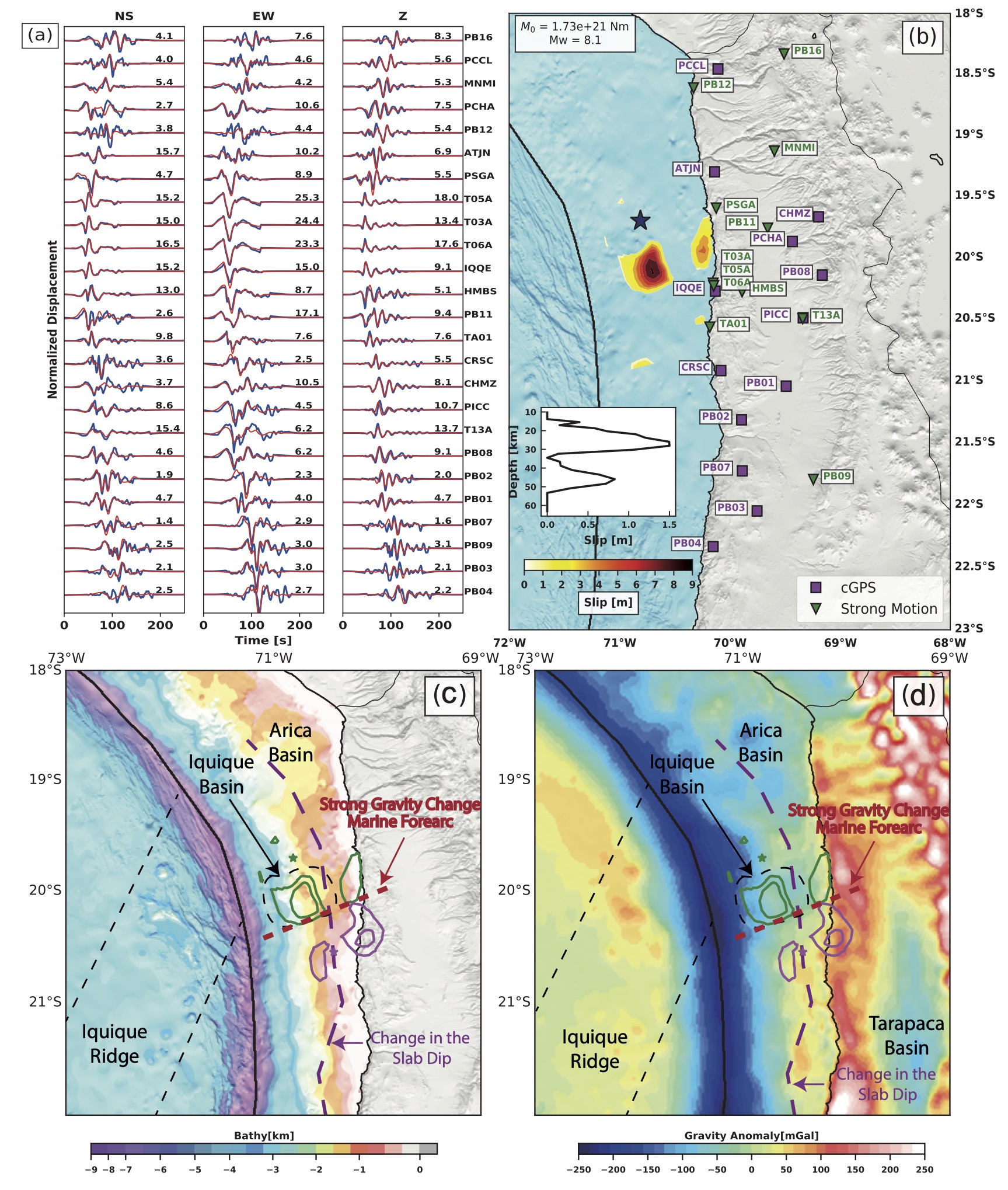
Figure 1. (a) Iquique EQ data (blue) and synthetic seismograms (red) with the kinematic slip model (b). (c) High-resolution topography and (d) free-air gravity anomaly. Mainshock (green) and aftershock (pink) slip contours are shown. The violet line marks the location of an abrupt change in slab dip.
I then focused on the northern Chile subduction zone, a region considered a mature seismic gap since the 1877 earthquake. In collaboration with colleagues, we examined why only a small fraction of the accumulated seismic moment had been released despite the occurrence of moderate events such as the 2007 Mw 7.7 Tocopilla earthquake. By jointly modeling seismic data and relocated aftershocks, we identified a pronounced change in slab geometry, with the dip increasing from about 10° to 22° at around 22°S (Figure 1). We interpret the prominent coastal scarp in this region as the surface expression of this slab-dip change. This geometric transition acts as a barrier to rupture propagation toward the trench, indicating that the megathrust is segmented not only along strike, but also along dip.
The region was later struck by the Mw 8.1 Iquique earthquake in 2014. Working within the same collaborative framework, we studied its rupture process, as well as that of its largest aftershock, using kinematic inversions in the frequency domain (Figure 1). The resulting slip models show clear segmentation both along strike and along dip (Figure 1). Along-strike segmentation appears to be associated with variations in lithology and fluid content within the continental wedge, whereas along-dip segmentation is linked to changes in slab dip and is accompanied by systematic variations in the frequency content of seismic radiation.
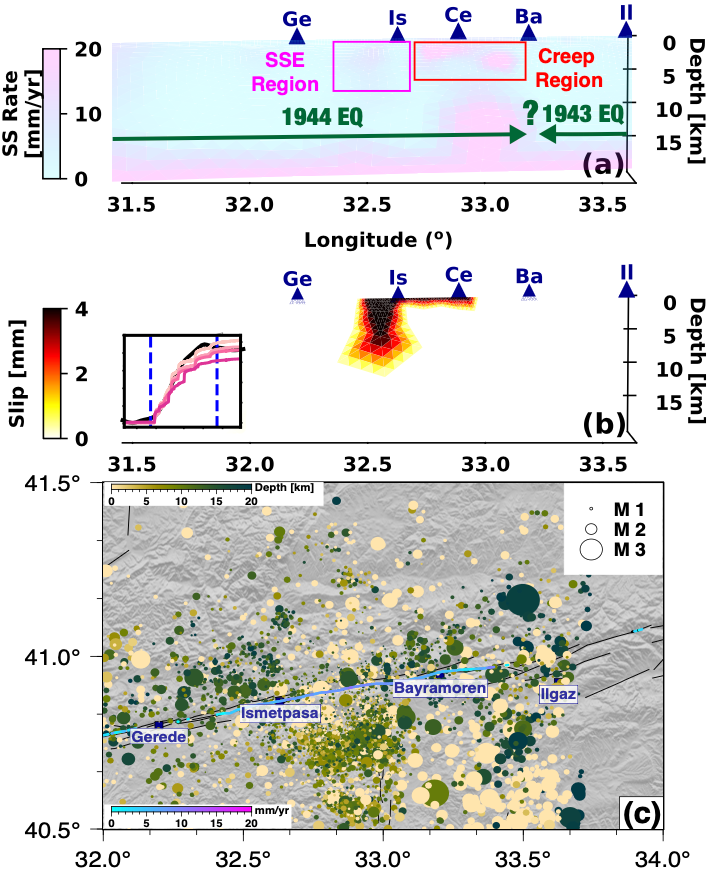
Figure 2. (a) Fault slip rate and (b) slip of the 2019 SSE in the NAF central section (Ismetpasa). (c) 2022–2024 EQ catalog from a local network.
I have extended this perspective on fault segmentation to continental strike-slip systems, particularly the North Anatolian Fault (Figure 2). Working in collaboration with colleagues, we investigated how this fault hosts repeated large earthquakes and displays pronounced along-strike and along-dip variations in slip behavior. Geodetic observations reveal locked segments separated by zones of aseismic creep, likely controlled by variations in fluid presence and lithological contrasts. These factors influence locking depth and rupture extent, emphasizing that segmentation is a fundamental property of fault zones across different tectonic settings.
Overall, this body of work shows that the traditional definition of seismic gaps, which focuses mainly on recurrence time and along-strike segmentation, is incomplete. Seismogenic zones are also segmented with depth, and this vertical structure plays a key role in controlling rupture dynamics and seismic hazard. Accounting for both along-strike and along-dip segmentation is therefore essential for a more realistic assessment of earthquake hazard and for understanding how tectonic systems evolve through the seismic cycle.
Relevant publications
Abrupt change in the dip of the subducting plate beneath north Chile.
Contreras-Reyes, E., Jara, J., Grevemeyer, I., Ruiz, S., & Carrizo, D. Nat. Geosci.. 2012, 5(5), 342–345. https://doi.org/10.1038/ngeo1447.
Sediment loading at the southern Chilean trench and its tectonic implications.
Contreras-Reyes, E., Jara, J., Maksymowicz, A., & Weinrebe, W. J. Geodyn., 2013, 66, 134–145. doi:10.1016/j.jog.2013.02.009.
Kinematic study of Iquique 2014 M 8.1 earthquake: Understanding the segmentation of the seismogenic zone
Jara, J., Sánchez-Reyes, H., Socquet, A., Cotton, F., Virieux, J., Maksymowicz, A., Díaz-Mojica, J., Walpersdorf, A., Ruiz, J., Cotte, N., & Norabuena, E. EPSL. 2018, 503, 131–143. doi:10.1016/j.epsl.2018.09.025
Daily to centennial behavior of aseismic slip along the central section of the North Anatolian Fault
Jolivet, R., Jara, J., Dalaison, M., Rouet-Leduc, B., Özdemir, A., Doğan, U., Çakir, Z. & Ergintav, S. JGR. 2023, 128(7), 1-35. doi:10.1029/2022JB026018.
The 2022 Mw 6.0 Gölyaka-Düzce earthquake: an example of a medium-sized earthquake in a fault zone early in its seismic cycle
Martínez-Garzón, P., Becker, D., Jara, J., Chen, X., Kwiatek, G., & Bohnhoff, M. Solid Earth. 2023, 14(10), 1103–1121. doi:10.5194/se-14-1103-2023.
Detecting millimetric slow slip events along the North Anatolian Fault with GNSS
Özdemir, A., Jara, J., Doğan, U., Jolivet, R., Çakir, Z., Nocquet, J.-M., Ergintav, S. & Bilham, R. GRL. 2025, 52, e2024GL111428. doi:10.1029/2024GL111428.
Progressive eastward rupture of the Main Marmara fault toward Istanbul
Martínez-Garzón, P., Chen, X., Becker, D., Núñez-Jara, S., Kartal, R. F., Türker, E., Dresen, G., Ben-Zion, Y., Jara, J., Cotton, F., Kadirioglu, F. T., Kılıç, T. & Bohnhoff, M. Science. 2025. doi:10.1126/science.adz0072.