About me
Welcome to my research webpage!
I am a geophysicist using seismogeodesy to understand the Earth's deformation and earthquakes. Currently, I am a researcher at the GFZ Seismic Hazard and Risk Dynamics team, in Potsdam, Germany.
Research Interests
My research focuses on understanding Earth's deformation at different spatio-temporal scales and its relationship to earthquakes. I am fascinated by how Space Geodesy (especially GNSS) and Seismology can be combined to understand better why and where earthquakes (will) occur. Additionally, I investigate the connections between hydro-meteorological processes and crustal deformation. I tackle such exciting problems along the Chilean subduction zone and the North Anatolian Fault.
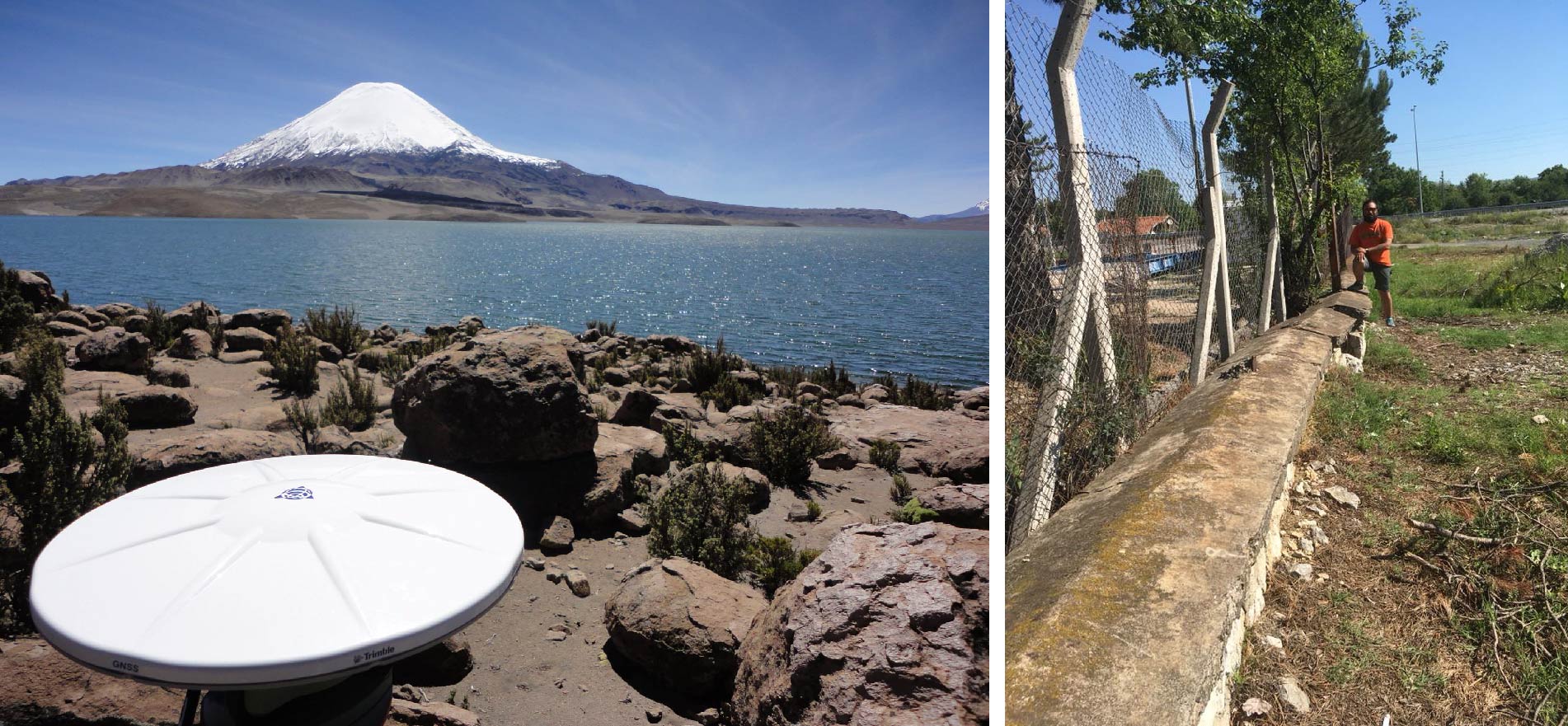
(Left) GNSS station at the Chungará Lake, northern Chile, 2014. (Right) Me, with one foot on the North Anatolian Fault in Ismetpaşa, Turkey, 2019.
News
December 2025: Our new article "Atmospheric Water Vapor and Precipitation Coupling in Southwestern South America" has been published in Geophysical Research Letters! We analyzed 15–27 years of GNSS-derived precipitable water vapor (PWV) across Chile, revealing how PWV–precipitation coupling varies with latitude and precipitation regime. See Publications section for more info.
December 2025: Our new article "Progressive eastward rupture of the Main Marmara fault toward Istanbul" has been published in Science! We analyzed the 2025 MW 6.2 Marmara earthquake and show a decade-long eastward migration of M>5 events along the Main Marmara Fault toward the locked segments near Istanbul. See Publications section for more info.
December 2025: Call for abstracts! We are convening session TS1.8 – Seismic and aseismic fault deformation at EGU General Assembly 2026 (Vienna, 3–8 May 2026). We welcome contributions exploring the diversity and interplay between seismic and aseismic slip phenomena, including the role of fluids, fault properties, and loading conditions in controlling fault slip behaviors. Observational, experimental, geological, and theoretical studies are all welcome! Convened with L. Dal Zilio, A. Bonnelye, P. Martínez-Garzón, and S. Michel. Abstract deadline: 14 January 2026.
November 2025: New preprint alert! Our study "Metamorphic dehydration reactions trigger slow slip events in subduction zones" is now available on ESSOAr. Using thermal modeling across nine subduction zones and phase equilibrium analysis, we show that slow slip events cluster at ~100°C and ~450±100°C—coinciding with major dehydration reactions in subducting sediments and oceanic crust.
November 2025: New preprint alert! Mario Arroyo-Solórzano's latest study "Subduction Parameters Controlling the Occurrence of Shallow and Deep Slow-Slip Events (SSEs) Revealed by Machine Learning" is now available on ESSOAr. Using decision-tree-based machine learning, we identify the key factors controlling SSEs globally: low dip angles, slow convergence, and fluid-rich conditions—with distinct depth-dependent patterns for shallow vs. deep events. Great job Mario!
November 2025: Postdoc position available! We are looking for a motivated early-career researcher (Ph.D. defended within the last 3 years) to join our team for the SEISCLIM project. The 2-year position focuses on integrating physics-based models with seismic hazard analysis. Application deadline: December 12th, 2025. More details available here.
October 2025: The SEISCLIM project has officially started. I have been awarded a grant from the Volkswagen Foundation through its Pioneering Research program at GFZ Potsdam. This project aims to understand the impact of climate change on seismic hazard. Ph.D. and postdoctoral positions will open soon.
August 2025: Our new article "Impact of geodetic information, subduction zone segmentation and slow-slip events in probabilistic seismic hazard: a case study for Costa Rica" has been published in Geophysical Journal International! This amazing work was carried out by Mario Arroyo-Solórzano during his Ph.D.—great job Mario! We propose a method to incorporate slow-slip events and geodetic data into probabilistic seismic hazard analysis, showing significant impacts on hazard estimates for Costa Rica's subduction zone. See Publications section for more info.
July 2025: I gave an invited talk at the FRENSZ 2025 workshop in Sampeyre (Italy), presenting our work on metamorphic dehydration reactions and their role in triggering slow slip events in subduction zones.
May 2025: We are at EGU General Assembly 2025 in Vienna! Come see our work: I'm giving a talk on EGU25-11371 on Friday 02 May in Room G2. Also check out Mario Arroyo-Solórzano's poster on machine learning and slow slip events (EGU25-7255, Fri 02 May, 10:45–12:30, Hall X3 | X3.15) and Angélica Buenrostro's poster on synthetic seismograms from physics-based rupture modeling (EGU25-6860, Wed 30 Apr, 10:45–12:30, Hall X1 | X1.135).
March 2025: Our new article "Detecting Millimetric Slow Slip Events Along the North Anatolian Fault With GNSS" has been published in Geophysical Research Letters! This work was carried out by Alpay Özdemir during his Ph.D.—great job Alpay! Using GNSS time series analysis and creepmeter data, we detected a MW 4.8 shallow slow slip event along the central section of the North Anatolian Fault, revealing how steady creep and transient SSEs interact spatially and temporally. See Publications section for more info.
January 2026. Pre-print alert! A new study led by Angélica Buenrostro (a.k.a. Monse), Ph.D. student at the Pontificia Universidad Católica de Chile, in collaboration with GFZ Potsdam, is now available as a pre-print. This work explores how epistemic uncertainty in rupture parameters propagates into earthquake source characterization, with direct implications for seismic hazard assessment in subduction zones. By combining kinematic rupture models with a rigorous uncertainty framework, the study highlights where current assumptions matter most and where future improvements are needed. The study builds on close collaboration between Chilean and German teams and is part of a broader effort to better integrate physical modeling and uncertainty quantification in seismology. See Publications section for more info.