
Hydro-meteorological forcing and seismic hazard
Hydro-meteorological forcing and seismic hazard
In recent years, my research has expanded toward understanding how hydro-meteorological processes interact with fault mechanics and influence seismic hazard. This direction builds naturally on my background in seismogeodesy and fault dynamics and reflects a broader effort to link solid Earth processes with surface and atmospheric forcing in a changing climate.
Since my second postdoctoral period at GFZ, I have been involved as P.I. and co-P.I. in several collaborative projects investigating the interaction between seismic and aseismic deformation along the central section of the North Anatolian Fault in Türkiye. Within this framework, we expanded an existing GNSS network, installed additional seismic instrumentation, and developed enhanced seismic catalogs using AI-based approaches. These efforts revealed persistent microseismicity concentrated near creeping fault sections and showed that aseismic slip during the interseismic period promotes seismic activity in the surrounding damage zone. Together, these results highlight how fault behavior evolves continuously in time and responds to relatively small stress perturbations.
Building on this seismogeodetic foundation, I am currently leading a new GFZ project explicitly focused on seasonality and hydro-meteorological forcing. The objective is to strengthen observational networks and to quantify how environmental loading, such as atmospheric pressure changes, precipitation, and snow accumulation, modulates seismic and aseismic slip. In parallel, together with collaborators, we are preparing a proposal to establish this region as a long-term observatory for aseismic slip, following approaches developed for the creeping section of the San Andreas Fault.
My interest in hydro-meteorological forcing is also rooted in interdisciplinary work at the interface between geodesy, meteorology, and climate science. GNSS observations provide a unique opportunity to study solid Earth deformation and atmospheric processes simultaneously, notably through estimates of tropospheric water vapor. As co-P.I. of a project in Chile, I collaborate on the analysis of long GNSS time series to investigate precipitation processes and extreme events across strong latitudinal and climatic gradients. Our results show that the coupling between tropospheric water vapor and precipitation varies systematically with climate regime, providing new observational constraints on hydro-climatic variability and extremes in central and southern Chile.
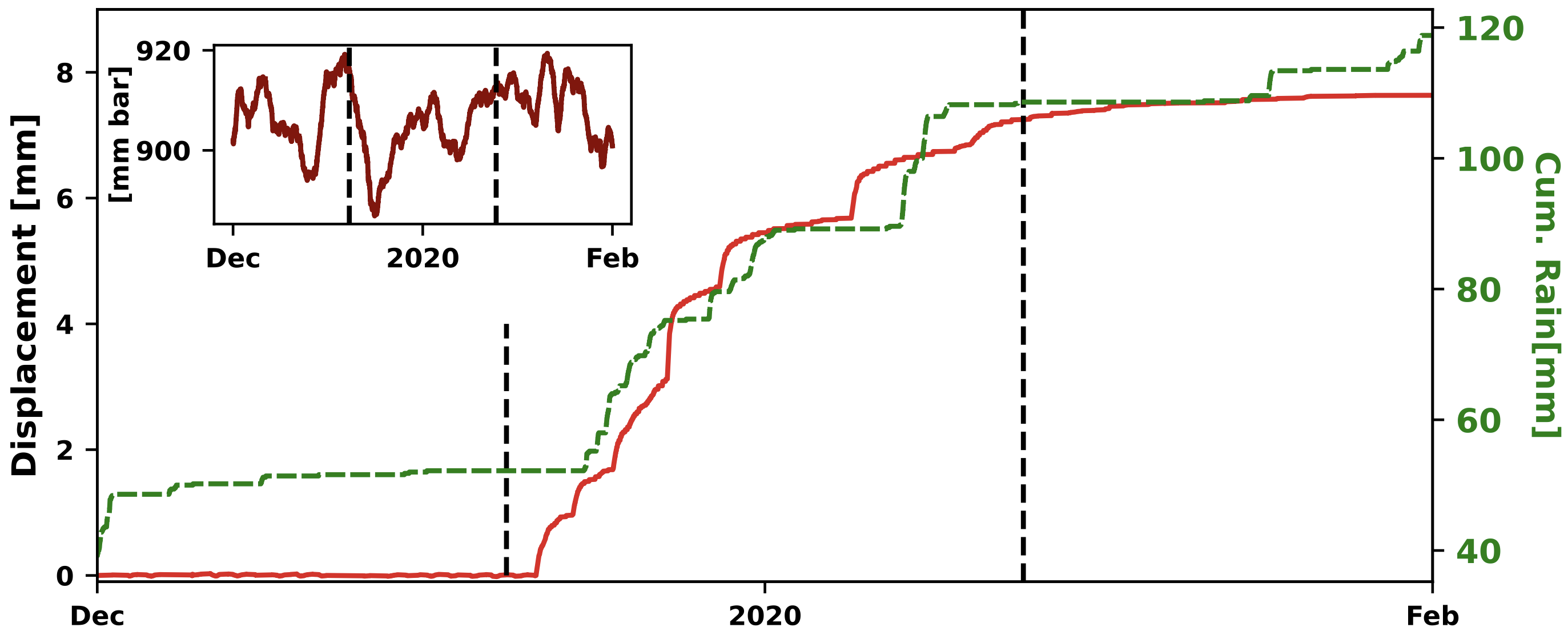
Figure 1. GNSS displacement time series (red, left axis) compared with cumulative rainfall (green dashed line, right axis) during a transient deformation episode. The inset shows atmospheric pressure variations over the same period.
These observational results motivated me to explore potential links between hydrology and seismotectonics more explicitly. Fieldwork and long-term monitoring in Türkiye reveal spatial correlations between zones of deformation, subsidence, and regions affected by intense rainfall and seasonal snow loading. In some cases, the timing of aseismic slip events coincides with large atmospheric pressure drops preceding major storms (Figure 1), suggesting that hydro-meteorological processes may perturb fault stresses at levels comparable to those required to trigger slip. Similar seasonal signatures have been identified in microseismicity in other regions affected by strong surface loading, reinforcing the need for systematic investigation of these effects.
To address this problem from a mechanical perspective, I am currently mentoring a postdoctoral project that explores how hydro-meteorological extreme events perturb fault slip using simplified spring-block models governed by rate-and-state friction. These simulations show that even small, time-dependent variations in normal stress can significantly modify recurrence times, background seismicity rates, and slip behavior, both for stick-slip faults and creeping segments. This proof-of-concept highlights the strong sensitivity of faults to stress perturbations of the same order of magnitude as those expected from hydro-meteorological loading.
Together, these observations and modeling efforts motivate a new research axis focused on integrating hydro-meteorological forcing into earthquake cycle models and seismic hazard assessment. In this context, I have recently been awarded a five-year grant from the Volkswagen Foundation to establish my own research group at GFZ. The project aims to quantify how climate-driven surface processes influence seismic and aseismic deformation and how these effects propagate into time-dependent seismic hazard. By combining dense geodetic and seismic observations, mechanical modeling, and probabilistic hazard frameworks, this research seeks to better capture the evolving nature of seismic hazard in a restless Earth increasingly impacted by climate change.
Relevant publications
Rain and small earthquakes maintain a slow-moving landslide in a persistent critical state
Bontemps, N., Lacroix, P., Larose, E., Jara, J., & Taipe, E. Nat. Commun. 2020, 11(1), 1–10. doi:10.1038/s41467-020-14445-3.
Daily to centennial behavior of aseismic slip along the central section of the North Anatolian Fault
Jolivet, R., Jara, J., Dalaison, M., Rouet-Leduc, B., Özdemir, A., Doğan, U., Çakir, Z. & Ergintav, S. JGR. 2023, 128(7), 1-35. doi:10.1029/2022JB026018.
Detecting millimetric slow slip events along the North Anatolian Fault with GNSS
Özdemir, A., Jara, J., Doğan, U., Jolivet, R., Çakir, Z., Nocquet, J.-M., Ergintav, S. & Bilham, R. GRL. 2025, 52, e2024GL111428. doi:10.1029/2024GL111428.
Atmospheric water vapor and precipitation coupling in southwestern South America
Valenzuela, R., Jara, J. & Martinez-Villalobos, C. GRL. 2025, 52, e2025GL119095. doi:10.1029/2025GL119095.