
Seismic Hazard
Earthquake rupture speed and high-frequency radiation
Earthquake damage is largely controlled by high-frequency ground shaking generated during rupture propagation. These high frequencies are closely linked to variations in rupture speed, which in most earthquakes remains bounded by shear or Rayleigh wave velocities. In some cases, however, ruptures can locally transition to higher, so-called supershear speeds. Understanding where and why these transitions occur is therefore essential for interpreting strong ground motion and earthquake destructiveness.
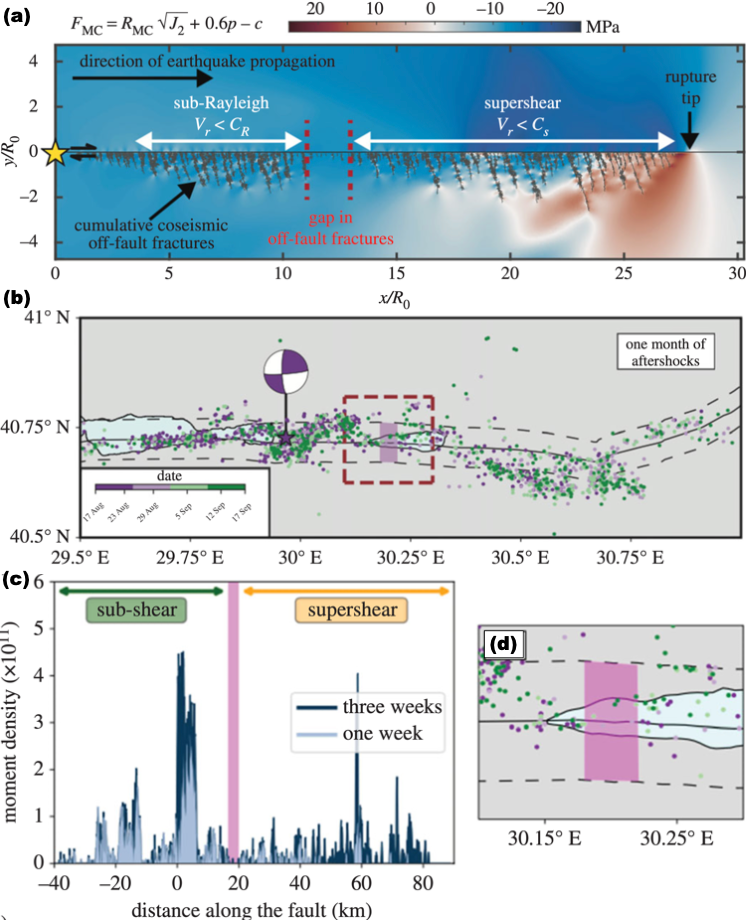
Figure 1. (a) Drucker-Prager failure criterion, including coseismic off-fault damage generated by the rupture propagation. (b) 1-month aftershock distribution for Izmit EQ, (c) Cumulative seismic moment density at different temporal scales (one to three weeks) for Izmit EQ. (d) Map view zoom on the transition region.
During my first postdoctoral work, I investigated this problem using theoretical arguments and numerical models that explicitly account for coseismic off-fault damage. This work showed that transitions toward supershear rupture are associated with a marked reduction in the width of the off-fault damage zone. We validated these predictions using natural observations, combining aftershock catalogs and image-correlation measurements of coseismic deformation. These results provided one of the first observational links between rupture speed, damage-zone structure, and high-frequency radiation, highlighting the role of fault-zone properties in controlling rupture dynamics (Figure 1).
In my second postdoctoral period at GFZ, I extended this work by studying the interaction between rupture speed, damage zones, and high-frequency shaking during the 2023 Türkiye earthquake doublet. Using the exceptional strong-motion dataset provided by Turkish colleagues at AFAD, together with a high-resolution relocated aftershock catalog and fault-width estimates derived from InSAR observations, we analyzed spatial variations in rupture behavior. We observed a clear contrast between rupture segments, with lower aftershock density and narrower damage zones in the southern segment compared to the northeastern one. Rupture velocities in the south approached the Rayleigh wave speed and exhibited strong variability, whereas the northern segment ruptured more slowly.
By analyzing velocity spectra, we found that regions characterized by variable rupture speed systematically excited frequencies in the 0.5–1.5 Hz range, a feature absent in slower rupture segments. This frequency band is particularly efficient at damaging mid-rise buildings, suggesting a direct link between rupture dynamics and observed destruction patterns. These results indicate that the spatial extent of the damage zone, observable through both geodetic and seismological data, exerts a primary control on rupture-speed variability and the associated high-frequency radiation. A manuscript based on this work is currently in preparation.
Background seismicity and earthquake hazard
Background seismicity, defined as earthquakes driven primarily by long-term tectonic loading rather than by direct triggering from preceding events, provides key insights into the evolving state of stress on faults. Its analysis allows the detection of long-term accelerations prior to large earthquakes, identification of regions affected by aseismic slip or seismic swarms, and recognition of secondary fault structures that progressively accumulate stress. For these reasons, background seismicity is a fundamental component of seismotectonic models and earthquake hazard assessment.
Since my Ph.D., I have worked on improving the estimation of seismic-catalog completeness and its associated uncertainties using Bayesian approaches. These developments have significantly refined background-seismicity analyses and have been applied to a range of tectonic settings, including the Himalayas, northern Chile, and the Upper Rhine Graben. Beyond improving catalog reliability, this work has contributed to a better understanding of tectonic loading and stress redistribution along major fault systems such as the North Anatolian Fault and its secondary structures, with direct implications for earthquake hazard.
Geodetic observations and probabilistic seismic hazard assessment
Probabilistic seismic hazard assessment (PSHA) has traditionally relied on seismological observations alone. However, the widespread occurrence of slow slip events and other forms of aseismic deformation raises fundamental questions about how geodetic observations should be integrated into hazard models. Since my second postdoctoral period at GFZ, I have been actively working on this problem through the Ph.D. thesis of M. Arroyo, whom I advise.
Focusing on the Costa Rican subduction zone, where recurrent slow slip events occur beneath the Nicoya and Osa Peninsulas, we developed a PSHA framework that explicitly accounts for the impact of aseismic slip. By combining seismic source definitions, frequency–magnitude distributions, and ground-motion models, we quantified how slow slip modifies the probability of exceeding given peak ground acceleration thresholds. Our results show contrasting effects, with a reduction of seismic hazard of about 15% in the Nicoya Peninsula and an increase of up to 30% in the Osa Peninsula, underscoring the complex interplay between aseismic and seismic deformation.
Building on this work, we are now extending the framework by incorporating Bayesian geodetic coupling models, allowing uncertainties in coupling and slip rates to be propagated through hazard calculations. In parallel, I am mentoring a postdoctoral researcher on the contribution of crustal faults to seismic hazard along the Chilean subduction zone. This work integrates geodetic slip rates and geological constraints on fault geometry into PSHA, with a particular focus on epistemic uncertainties. Preliminary results indicate that accounting for crustal faults can increase expected ground-motion levels by up to about 20% in nearby urban areas. These developments aim to provide more realistic, transparent, and reproducible seismic hazard assessments, supported by open-source tools following FAIR principles.
Relevant publications
Long-Term Interactions Between Intermediate Depth and Shallow Seismicity in North Chile Subduction Zone.
Jara, J., Socquet, A., Marsan, D., & Bouchon, M. GRL. 2017, 44(18), 9283–9292. doi:10.1002/2017GL075029.
Suspected Deep Interaction and Triggering Between Giant Earthquakes in the Chilean Subduction Zone
Bouchon, M., Marsan, D., Jara, J., Socquet, A., Campillo, M., & Perfettini, H. GRL. 2018, 45(11), 5454–5460. doi:10.1029/2018GL078350.
Seismogenic Potential of the Main Himalayan Thrust Constrained by Coupling Segmentation and Earthquake Scaling
Michel, S., Jolivet, R., Rollins, C., Jara, J., & Dal Zilio, L. GRL. 2021, 521, 46-59. doi:10.1029/2021GL093106.
Seismogenic potential of northern Chile subduction zone
Michel, S., Jolivet, R., Jara, J. & Rollins, C. BSSA. 2023, 113(3), 1013-1024. doi:10.1785/0120220142.
Update of the Seismogenic Potential of the Upper Rhine Graben Southern Region
Michel, S., Duverger, C., Bollinger, L., Jara, J. & Jolivet, R. NHESS. 2023, 24, 163–177. doi:10.5194/nhess-24-163-2024.
The 2022 Mw 6.0 Gölyaka-Düzce earthquake: an example of a medium-sized earthquake in a fault zone early in its seismic cycle
Martínez-Garzón, P., Becker, D., Jara, J., Chen, X., Kwiatek, G., & Bohnhoff, M. Solid Earth. 2023, 14(10), 1103–1121. doi:10.5194/se-14-1103-2023.
Signature of transition to supershear rupture speed in the coseismic off-fault damage zone
Jara, J., Bruhat, L., Thomas, M. Y., Antoine, S. L., Okubo, K., Rougier, E., Rosakis, A. J., Sammis, C. G., Klinger, Y., Jolivet, R., & Bhat, H. S. PRSA, 2021, 477(2255). doi:10.1098/rspa.2021.0364
Impact of geodetic information, subduction zone segmentation and slow-slip events in probabilistic seismic hazard: a case study for Costa Rica
Arroyo-Solórzano, M., Jara, J., Weatherill, G., González, A., Hidalgo-Leiva, D. A. & Cotton, F. GJI. 2025, 242, 1–33. doi:10.1093/gji/ggaf204.
Progressive eastward rupture of the Main Marmara fault toward Istanbul
Martínez-Garzón, P., Chen, X., Becker, D., Núñez-Jara, S., Kartal, R. F., Türker, E., Dresen, G., Ben-Zion, Y., Jara, J., Cotton, F., Kadirioglu, F. T., Kılıç, T. & Bohnhoff, M. Science. 2025, online ahead of print. doi:10.1126/science.adz0072.